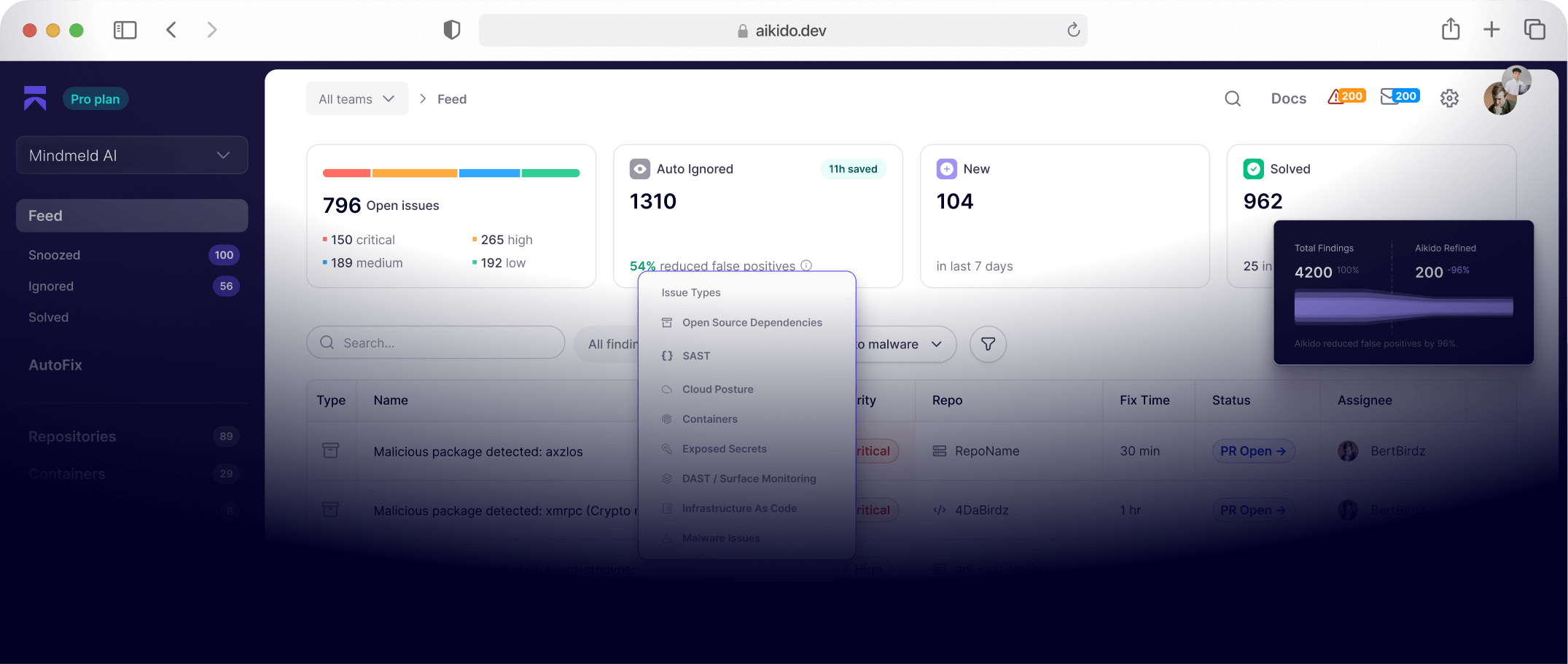
Deeper SAST. Better coverage. Less noise.
Semgrep scans code. Aikido secures the entire developer workflow.
From code and dependencies to containers and cloud infrastructure.



Where Aikido's SAST goes further
Aikido focuses on the entire developer security workflow.
Where the cracks will
show if you use Semgrep
To secure modern applications,
teams typically need additional tools for:
So teams using Semgrep end up adding several extra tools, creating...
Aikido's SAST vs Semgrep SAST
3.2x
10x
16+
How Aikido compares to Semgrep
Semgrep does SAST & SCA. Aikido does that — plus DAST, Cloud, and Runtime, affordably priced.


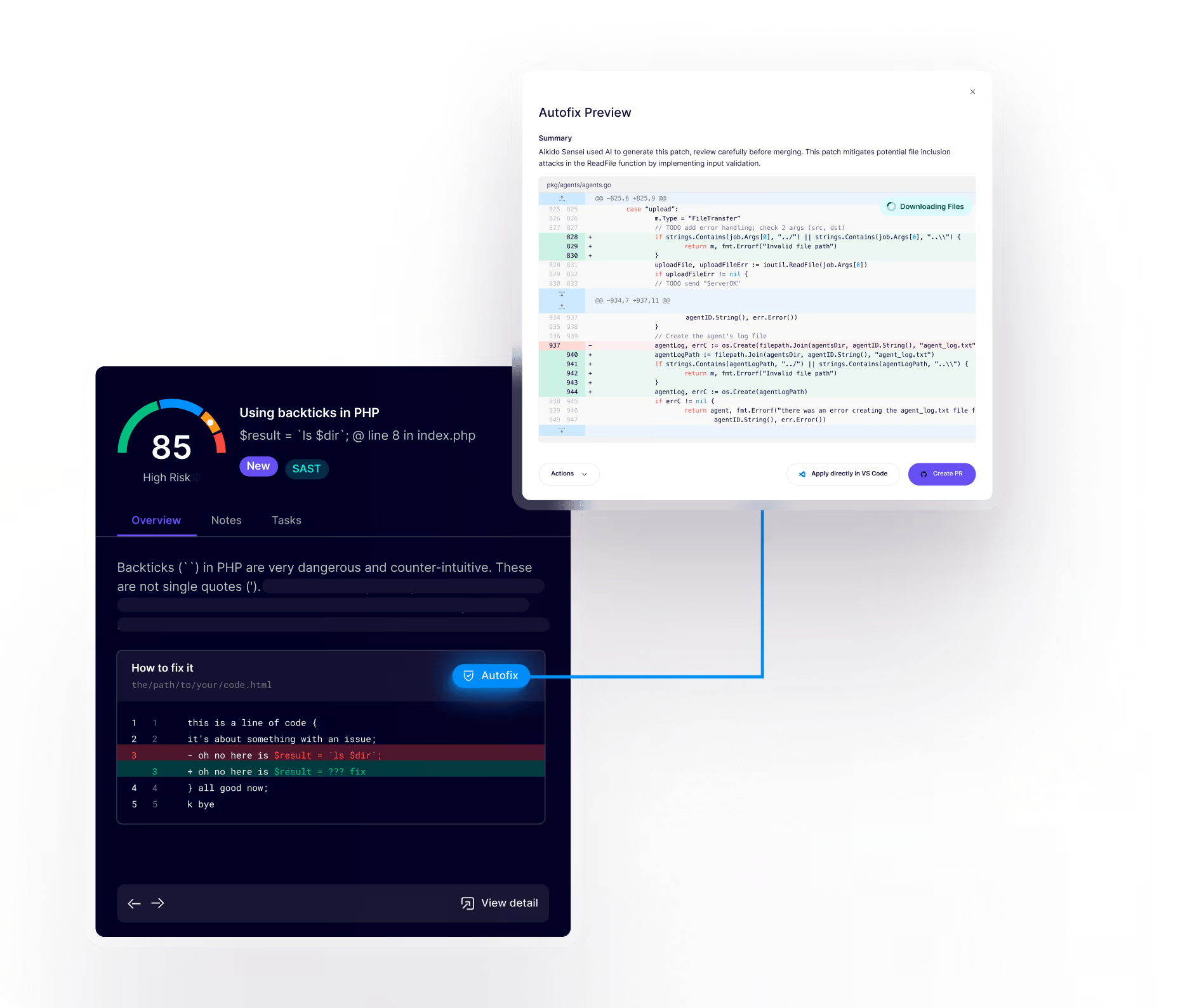
- SAST AI Autofix
- Multi-file Analysis
- Taint Analysis
- Custom SAST Rules
- SAST Issues Directly in IDE
- Experimental
- Reachability Analysis
- Malware Detection in Dependencies
 Aikido has extensive malware detection for many systems
- AutoFix For SCAAikido has extensive AutoFix language coverage and works in SCA, Containers & IaC.
- License Compliance
- SBOM Support
- License PR Release Gating
- Noise Reduction (False Positive Filtering)

- Limited (Js & Python)
- Limited (Js, Python, Go)
- Noisy (Reported by user reviews)
How users rate Aikido vs Semgrep
.png)

"Aikido reduces noise through reachability analysis, highlighting vulnerabilities that are actually exploitable rather than flagging every theoretical issue."
Migrating to Aikido
This is the migration hub for teams replacing an incumbent code, cloud, or supply-chain security tool with Aikido. The safe pattern is phased: onboard assets, preserve evidence, route ownership, run in parallel, then move enforcement one capability at a time.
Who this is for
Security leads, platform engineers, and CTOs migrating any incumbent code, cloud, or supply-chain scanner to Aikido. That includes teams replacing older SAST programs, point tools, or multi-tool stacks and wanting one rollout pattern that works across repositories, cloud accounts, container registries, and related scanning surfaces.
The migration pattern in one paragraph
Aikido migrations are usually run as a phased overlap, not a freeze-and-cutover event. Start with visibility, keep one tool as the blocker while the other measures, baseline historic debt so only net-new issues drive enforcement, make sure every onboarded asset has an owner, preserve legacy evidence in read-only form during the overlap, and cut over by capability or category rather than by one big-bang retirement date.
The migration playbook (any path)
Visibility first, blocking later
Connect the assets you want to migrate first, confirm coverage, and let teams see findings before you enforce on them. The early goal is signal quality, ownership, and workflow fit — not day-one blocking.
Parallel run: one tool blocks, the other measures
During overlap, avoid double-blocking. Keep the incumbent tool as the active blocker for a capability while Aikido runs in measurement or warn-only mode, then swap roles when you are ready to cut over. One tool blocks; the other measures.
Baseline historic debt vs net-new
Treat historic findings as baseline debt and keep enforcement focused on net-new issues. That gives teams a clean starting point and avoids turning migration week into a backlog reset project.
Ownership and smart issue routing
Do not onboard a repo, cloud account, registry, or app surface without an owner. Before enforcement, set teams, CODEOWNERS, any path-based assignment you plan to use, and Jira smart routing so new findings land with the right team from day one.
Audit and evidence continuity
Keep the old tool's evidence read-only during the overlap for audit continuity. For ongoing evidence in Aikido, use the Security Audit Report and the available export and integration surfaces: PDF report export, issue export, activity log API, SBOM and VEX export, REST API, webhooks, and Vanta integration.
Cutover and decommission criteria
Cut over by capability or category, not by one calendar date. For example, move one category at a time from report-only to enforcement, confirm routing and evidence collection are working, then decommission the incumbent tool for that category. Full retirement follows once the categories you care about have clean ownership, stable gating, and acceptable evidence coverage.
Vendor-specific migration guides
- Migrating from Snyk to Aikido — practical guidance for moving from a multi-product developer AppSec stack to Aikido.
- Migrating from SonarQube to Aikido — guidance for teams moving from code-quality and SAST-led workflows to broader coverage in Aikido.
- Migrating from Semgrep to Aikido — guidance for teams replacing custom-rule-heavy SAST workflows with Aikido.
- Migrating from Checkmarx to Aikido — guidance for replacing a legacy SAST rollout with a lower-friction transition path.
- Migrating from Veracode to Aikido — guidance for moving from scan-cycle-driven AppSec to a continuous Aikido rollout.
Onboarding surfaces
Aikido onboards across source code management systems, cloud accounts, container registries, and, where documented, DAST / Surface Monitoring app domains. Before enforcement, configure teams, CODEOWNERS and assignment rules, roles and permissions, task-tracker routing, and SAML / SSO so the rollout model is already in place when blocking begins.
Related resources
See the difference in 5min
Connect your repos, get prioritized findings, and see why 100k+ teams chose Aikido. No credit card required.